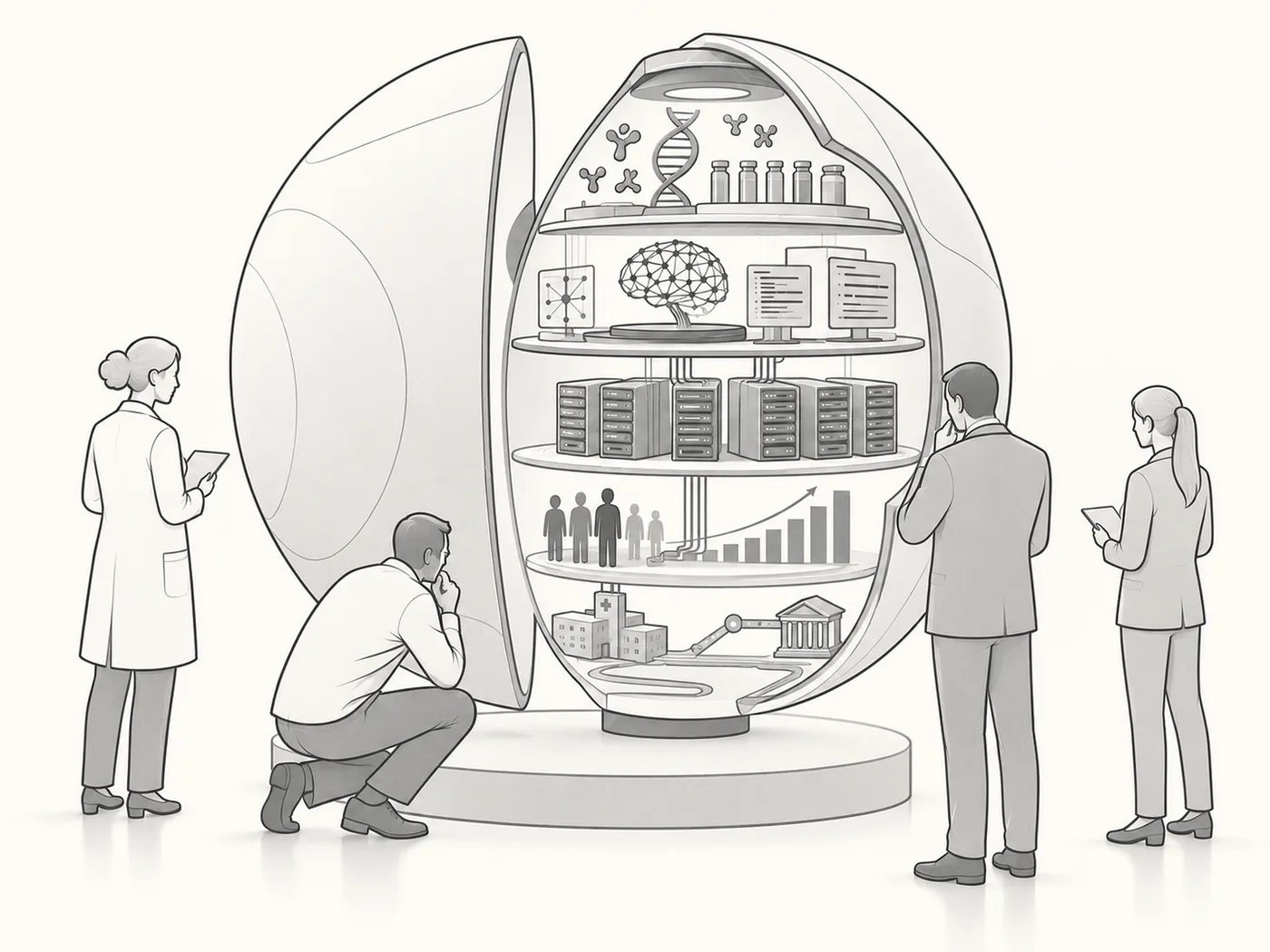
HyIQ helps investment firms and life science companies evaluate opportunities, resolve technical uncertainty, and make consequential business decisions. Our work connects scientific evidence, AI and software architecture, compute economics, and the realities of adoption.
Who we advise
Investment firms
We advise investors on separating technical possibility from durable advantage by examining scientific evidence, architecture, data dependencies, compute economics, and adoption. The objective is not to confirm that a technology works, but to understand what its technical realities imply for differentiation, scalability, capital requirements, and ultimately the investment thesis.
Life science leaders bring decades of essential judgment developed across scientific, clinical, and business domains, often adjacent to the current technological moment. The institutional scars left by technology deployed without sufficient regard for enterprise realities are not lost on us.
HyIQ brings a complementary specialty: helping clients determine whether a problem is fundamentally technological, organizational, or operational before deciding where the enterprise should invest. Where technology solutions are warranted, we teach industry leaders to reason from first principles about how sophisticated software and hardware systems should be deployed, and the constraints those deployments impose. We advise leadership on making the enterprise data ready and establishing a disciplined cycle of simple implementation, learning, and iteration. The objective is not an abstract technology strategy, but simple technical foundations that evolve into durable solutions.
Evaluate scientific claims, technical credibility, validation, data quality, and the evidence supporting the investment thesis.
AI, software, and platform assessment
Examine AI models, scientific software, research platforms, technical differentiation, workflow fit, and internal versus external capabilities.
Compute and infrastructure economics
Assess cloud and private infrastructure, GPU and accelerator strategy, utilization, cost, procurement, scalability, and capital requirements.
Market, customer, and adoption analysis
Understand purchasing criteria, adoption, pricing, budgets, switching, renewals, customer experience, and the sources of durable advantage.
Clinical, regulatory, and commercial diligence
Evaluate clinical development technologies, regulatory and compliance platforms, commercialization tools, service providers, and operating dependencies.
What you receive
An evidence-based decision brief: thesis implications, material risks, unresolved questions, and the next diligence worth doing.
Prioritize AI and machine learning opportunities, decide what to build, buy, fine-tune, or partner on, and align technology choices with scientific and business priorities.
Scientific platforms and data readiness
Connect scientific software, computational biology, research tools, data quality, interoperability, governance, and model development into usable enterprise foundations.
Compute and infrastructure strategy
Design cloud, private, or hybrid infrastructure around workload requirements, model ownership, GPU and accelerator choices, cost, capacity, and governance.
R&D and laboratory transformation
Improve discovery workflows, laboratory automation, lab-in-the-loop systems, instrumentation, scientific IT, research productivity, and portfolio execution.
Clinical and regulatory transformation
Apply AI and software to regulatory writing, intelligence, compliance, and clinical research workflows.
External partnerships
Evaluate outsourcing, service providers, partner selection, partnership models, and the structures required to support execution.
Commercial and enterprise AI
Use AI, analytics, and software across forecasting, launch planning, field engagement, lifecycle management, market access, and enterprise decision-making.
What you receive
A decision-ready strategy and roadmap: prioritized choices, technical dependencies, resource assumptions, and milestones for implementation.
We engage where technology can materially change the outcome. Client and advisor begin by establishing the business objective, the relevant constraints, and whether technological intervention offers a credible path to value. Where it does, we define the mandate around that opportunity. Where it does not, we identify the constraint before unnecessary investment is made.
Hourly advisory
Focused expertise, as needed.
For focused questions, technical reviews, working sessions, and situations where the scope is expected to evolve. Work is billed for the time required.
Project-based engagements
Defined scope. Agreed deliverables.
For defined objectives with an agreed scope, deliverables, and timeline. Fees are established in advance based on the requirements of the engagement.
We agree the appropriate structure, scope, and commercial terms before substantive work begins.
Our perspective
Reason from first principles.
We reason from first principles because established categories, vendor narratives, and historical analogies can obscure the constraints that actually determine whether a technology will work. We begin by reducing the problem to what must be true across the science, data, software, hardware, economics, and operating environment. From there, we rebuild the decision around evidence: what has been demonstrated, what the system requires, which constraints are fundamental, and which can be engineered around. The purpose is not abstraction for its own sake. It is to understand the system well enough to distinguish capability from claim, identify the consequences of deployment, and make decisions grounded in how the technology actually behaves.
What we examine
The connections that change the assessment.
01
Adoption
What is being used, by whom, and for which workflows?
02
Value
How does the technology affect scientific outcomes, productivity, costs, or timelines?
03
Selection
Which solutions were evaluated, why was one chosen, and what differentiates them?
04
Economics
What are the prices, spending levels, order volumes, budgets, and capacity commitments?
05
Build versus buy versus partner
Which capabilities should remain internal, and which should be purchased or outsourced?
06
Market dynamics
What drives growth, adoption barriers, vendor switching, renewals, and customer retention?
07
Partnerships
How are collaborations structured, implemented, and supported?
About HyIQ
Science, engineering, and strategy in one conversation.
A useful assessment must be able to move from a scientific hypothesis to model evaluation, from software architecture to compute cost, and from a technical result to a business priority. HyIQ brings these perspectives together so that important dependencies do not disappear between specialist workstreams.
Meet the founder
Ade Ojewole, PhD
Founder & Managing Partner · HyIQ Partners
We advise investment firms and life sciences companies on the scientific, technical, and operating assumptions behind consequential decisions. Our experience spans biological AI platforms at NVIDIA, enterprise AI and accelerated computing at Eli Lilly, and bespoke analysis for major investment firms. That background connects scientific evidence with software, hardware, compute economics, and the realities of enterprise adoption.
Bring the question. Build a clearer basis for the decision.
Share the decision you are considering and the context in which it needs to be made. Please do not send confidential materials in an initial email. Scope, confidentiality, and potential conflicts should be addressed before substantive information is exchanged.